
The Works of Andrés Sanz: a (non) systematic review.

The items posted here are notes, ideas and (moving) pictures that were part of the creative process during the making of my work.


Check out Flat Love LATEST NEWS in Facebook!

Flat Love (2009)

Flat Love (2009)

28 March 2009

Flat Love: Casting D. H. Johnson

I met D.H. when I was studying Film at the University of North Carolina, Greensboro and he was a student in the Theatre department. We worked together in a few small projects for the school but the most important collaboration of that time was in the short film that I produced, wrote and directed, Emily, Greensboro 1995. He played the narrator of the story so brilliantly that his voice and performance is one of the reasons why “Emily” still remains my favorite work.

Emily, Greensboro 1995 (1995)

After one year in Greensboro, I moved to San Francisco and later to New York. While D.H. remained in North Carolina, we often kept in touch. A new opportunity for collaboration arrived when D.H. showed up in New York City. I was finishing editing my new film Bedford and I needed a voice over. Again, he did a masterful work as the mysterious, ironic and melancholic narrator of Harry Bedford’s adventures.

Matt Boethin as Harry Bedford in Bedford (2004)

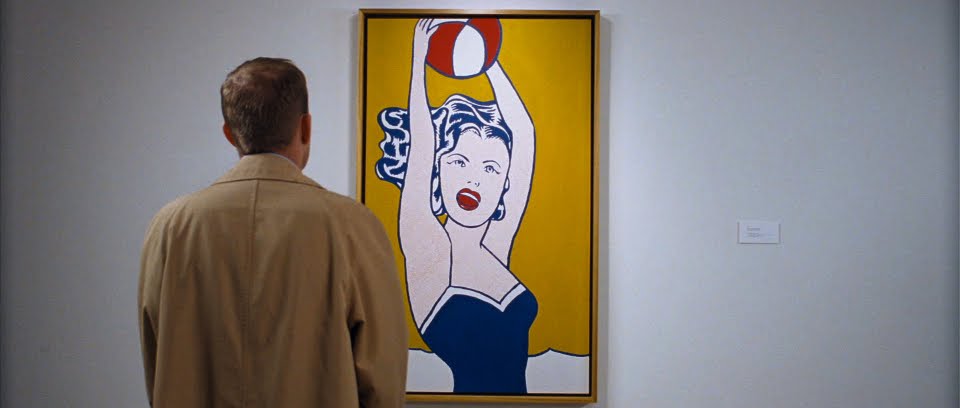
So after two major performances as a narrator, I owed him a role where he could put more than his voice to work.  From the very start, the man in love with the girl in the Roy Lichtenstein’s painting was going to be Mr. D.H. Johnson.


26 March 2009

Flat Love: Storyboards.

After drawing several drafts of the storyboard, I usually lay out the sequences using Post-its on a white board. That helps me to visualize the entire film like a map or a pentagram. This way I can check the visual rhythm, duration and the gaps or holes in the story.


I don’t spend too much time finishing the storyboards. I’m not interested in making beautiful drawings but simple ones that tell the story. As an example, I’m posting a few pages of an old draft of the script, which includes an alternative version for the third act of FLAT LOVE.


13 March 2009

Flat Love: Drawing the screenplay.


I normally don’t write a screenplay. I draw it. The film comes alive as a sequence of images on paper instead of words. This way I can “catch” the film I have in my mind.

I usually like to sketch to understand a concept and I remember something better if I associate it with images. Sometimes while riding on the subway, I draw on a piece of paper to memorize an idea I have and I even draw the recipes my mother tells me by phone.


When they asked me for the screenplay of my previous film Bedford to be published in a book, I had to send them the storyboards since I didn’t have a screenplay per se.

I believe you can still find the book ("VI Concurso Iberoamericano de Cortometrajes Versión Española/SGAE") on www.factoriautor.com.

06 March 2009

Flat Love: The girl with kaleidoscope eyes.


The third character to complete the love triangle of FLAT LOVE was born in the waters of Lichtenstein’s ‘Girl with Ball’. I imagined another girl inside the painting, concealed by the waves, swimming behind the pin-up. She could be in love with the man who looks at the painting and, therefore, madly jealous of the girl with the ball. She’d be so tiny that we couldn’t see her unless we were half an inch from the picture. She was not a pin up, a glamorous type, or a sexual fetish. I gave her the name Tina.

For some reason, when I thought of this tiny girl hidden behind the waves, I couldn’t help but recall The Beatles’ song, ‘Lucy in the Sky with Diamonds’,

“Picture yourself in a boat on a river,

With tangerine trees and marmalade skies.

Somebody calls you, you answer quite slowly,

A girl with kaleidoscope eyes.”


What if Tina was wearing red and blue 3-D glasses? Fun.

But, the problem was, afterwards, to come up with a story where the three characters and main elements (painting, 3D glasses) could make any sense.

Well, it took me some time…


01 March 2009

Flat Love: The Painting (II).


But then, in a closer look, this “effigy of femininity” looks quite bizarre. Her head is too big in proportion to the body and arms. The hands are too tiny. Or should I say "the hand", since the right one is hidden behind the ball? (This mysterious "other" hand could be very well an extremely gigantic appendix almost covering the whole ball, or it may not be a hand at all). Also there is the hairdo with those strange shiny, oily waves, suspended in mid air, fixed like a cheap wig. And finally: the mouth. In the center of the painting, there is this red void, an obscene hole permanently open. What kind of expression is that? Try posing with your mouth that open and you'll see how silly you look… like a blow-up doll. 

She's definitely a caricature, weird and grotesque. But we can't avoid looking at her. She attracts our attention, flirts with us… Suddenly, she doesn't seem monstrous any more. She got personality, charisma. She's kind of cute, actually.

Still, there is something uncertain, unresolved in this “effigy”. She is holding the ball, holding the ball, holding the ball... She's not throwing it nor catching it, not running or jumping. Right in the middle of the action, she stays still, like The Statue of Liberty at play on a summer day in Coney Island. She's posing. She proudly shows her clean, shaven armpit, her perfectly rounded breasts and stays like that forever, holding the ball for all eternity.


Besides, there is something more disturbing in the image: the sea, the waves of the sea (or is it an ocean?) showing behind her waist. The artist has violently cut the girl in half by the waist so we can't see where she's standing. Another mystery: Is she in the water? She doesn't look wet... I assume she is ashore and the water is far behind her. Obviously, it is a windy day, the water swings and her hair undulates. They are the only two elements really moving in the picture while the girl stays in her tense position holding the ball. If the girl were in the water, it would be very difficult to keep her posture because she would be pushed constantly by the waves. So we could assume that the water is behind her. And this is what really confounds me the most. Because if the water is behind the girl... I ask myself: What is behind the water? I approached the painting and I looked extremely close. I put my eye right on the tip of the wave and I saw something. Or I should say, I imagined something.  There was somebody behind the wave. Somebody swimming in that sea or ocean or whatever it is. Somebody else was behind that girl, behind that wave: another girl with kaleidoscope eyes. 


25 February 2009

Flat Love: The Painting (I).

Girl with Ball. 1961. Work of Mr. Roy Lichtenstein (American, 1923-1997).  

Lichtenstein was inspired by an advertisement of a lodge for honeymooners, in the Pocono Mountains. The black and white ad, like the painting, shows the stereotypical 50's American girl (the pin up), with wavy shiny long hair, open mouth with full lipstick, a healthy and curvaceous body and a direct, "I'm having a good time" attitude. The advertisement people were selling the same thing they are selling now: sex.
So Lichtenstein takes the stereotype and pushes it beyond itself, creating a pop idol of an American pin-up. The girl from the advertisement is transformed from a photorealistic dull pin up into a comic book effigy of XX century American femininity.


22 February 2009

Flat Love: Girl with Ball.

Roy Lichtenstein's painting changed my project considerably.  It focused the theme, the characters, it gave me a visual style, but most importantly, it provided me with a soul. So now, if I go to the MOMA, no matter what, I have to pay a visit to ‘Les Demoiselles’ and to ‘Girl with Ball’.  On the other hand, you don’t really need to enter the MOMA to see her nowadays. She’s out there, all over 53rd Street. You can’t miss her...


16 February 2009

Flat Love: The Girl at the MOMA.

I developed this idea (a man and a woman are in love but they live in two separate spatial dimensions) for a few weeks until I had a magical encounter with a girl at the Museum of Modern Art (MOMA). It changed everything.

I had met her before (after all, she is quite a celebrity) but I had never really noticed her. But one afternoon, I went to the MOMA to see the giant retrospective of the great Lee Friedlander, which was an overwhelming, mind blowing and exhausting experience (more than 500 photographs). Although I was pretty tired, since I was at the museum, I had to pay my obligatory visit to the ladies: Les Demoiselles d'Avignon. I could stay in front of them for hours on end...

Then I wandered around the galleries and I saw her: a brunette with huge eyes and full red lips, wearing a dark blue bathing suit and holding a read & white beach ball. 

In some unexplainable way, I felt as if she was the one who chose me and not the other way around. 

Yes, you may think I'm crazy but she was looking at me...


15 February 2009

Flat Love: The Early Script.

I draw more than a I write. Many of my ideas begin with improvised sketches. Sometimes an image comes out of my mind and finds its place in the story many months later.
In the case of FLAT LOVE, I started with a storyboard that resembled an experimental silent film.
Two lovers, a man and a woman, are always looking at each other but they're never in the same place; they never share the same space. While the man stays in a third dimensional world, he looks at a woman who is watching him from a two dimensional world. They both know they're watching each other and that they're in love but they never make contact. It is an impossible love. Later, we see that the man becomes a picture and then it is the woman who is looking at him in a third dimensional space. Ultimately, the story ends with the audience looking at both man and woman on a flat, two-dimensional screen (that is the movie or TV screen). Perhaps, we are also players moving on a flat surface unaware of being watched by somebody else, outside…