
Flat Love was recognized with "Best Comedy" and "Audience Award" at the 5th Annual New York City Short Film Festival. http://www.nycshorts.com/




 1 Reel Film Festival, Seattle USA September 5, 2009 7:00 PM
 Festival de Cine de Madrid PNR, España Septiembre 11, 2009 5:00 PM
 New York City Short Film Festival, USA Friday, Sept 11 @ 7pm & Saturday, Sept 12 @ 9pm
 San Diego Film Festival, USA Friday, Sept 25 @5:30 pm & Saturday, Sept 26 @3:00 pm
 Festival de Cine de Ponferrada, España Septiembre 23 - Octubre 3
 Abycine - Festival Internacional de cine de Albacete, España Septiembre 25 - Octubre 2
 Festival de Cine Solidario de Guadalajara, España Septiembre 29 - Octubre 3
 Festival de Cine de Bogotá, Colombia Octubre 1-9
 Festival Internacional de Cortometraje y Cine Alternativo de Benalmádena FICCAB, España Octubre 16-24
 43rd Hof International Film Festival, Germany October 27 - November 1
Flat love recibió el pasado 29 de agosto, durante la Cena de Gala de Clausura,
el Premio Luna de Islantilla al Mejor Cortometraje.
Palmarés de la II edición de Islantilla Cinefórum:
Mejor Cortometraje.- Flat love de Andrés Sanz
Mejor Dirección.- Mateo Gil por Dime que yo.
Mejor Actor.- Luis Callejo por Quid Pro Quo.
Mejor Actriz.- Francesca Piñón por Turismo.
Mejor Guión.- Irene de Lucas por Le jeu de dames.
Mejor Fotografía.- José David Montero por Retrato de mujer blanca con navaja.
Mejor Música Original.- Fernándo Velázquez por Dime que yo.


“Andres,
This just came to me the other day....
What about Barton Fink?
There is the image of the woman on the beach that hangs in his LA hotel room. It is located above his writing desk on the wall behind which Charlie Meadows resides (John Goodman, the Everyman of Pain and pent up rage). It serves as an image of desire, the unknown, wide open potential, the Californian dream, etc.
It isn't exactly a "painting". More like a vacation print or commemorative platter sold to tourists. But I think it recalls the kind of movie you are talking about where someone studies a painting longingly. The cheap reproducibility of the image echoes the way Barton sees the movies and resonates when he sees "the real girl" on the beach. He says "You are so beautiful... are you in the pictures?" He is obsessed with authenticity, and won't own up to the "base" nature of his inspiration (cheap plate with mass-produced image of beautiful lady at beach).
Just a thought."


"Dear Sean,
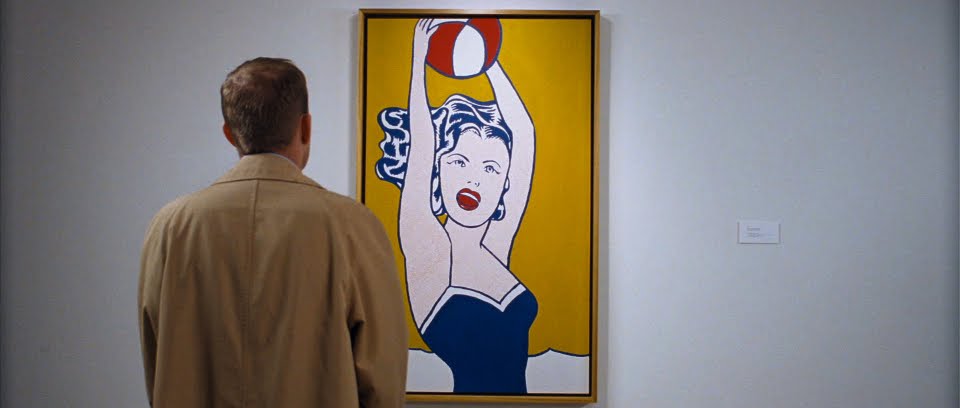
Yes, you were right about the scene in Barton Fink with the postcard of the beach girl. I remember it had a profound effect on me when I saw the film... I almost forgot it until you brought it up. I'm pretty sure now that Barton's postcard was playing deep down in my head while I was writing Flat Love. Maybe that's the reason behind choosing the Lichtenstein's painting... Funny... I wasn't aware of it until now... Something clicked in my brain when I saw "Girl with Ball" at the MOMA. It may have been the Barton Fink's postcard... sitting somewhere in my unconscious... Weird..."


"Andres,
To me the resurfacing of an image (in an altered form) that you might have first encountered elsewhere is the core of the artistic/symbolic experience. Orpheus goes to the underworld. AND COMES BACK with something. Most people never go. Or if they do, they don't come back. To come back is to be altered. To bring something back is to acknowledge the change that has taken place within you and try to share it with others.
Most people see the thing and the resonance subsides and only dimly resonates with some aspect of their lives (a fleeting sensation of deja vu that is shrugged off). The artistic temperament is to sense the change in yourself and to investigate it and share what you've learned from your experience. To tap in, and to channel the flow (altered by your experience and your sensibility). Everything you've ever done or experienced influences you and permeates who you are and what you create. Or something like that.
Barton Fink's obsession with authenticity and pain and authentic pain reminds me of the heroin obsession of the early 1990s. Those people who, like Barton Fink, only think that artistic inspiration can come from deep psychological pain. But when confronted with his own inner Charlie Meadows, Fink is totally aghast. His search for the "common man" has led him to a dark place full of rage. Some people feel like they have to destroy their lives before they have anything of interest to share in their art. Whereas I would say that art is what helps us survive. Which can be related to good days, bad days, mundane days, every day.
Anyhow. It is weird (and exciting) when images that were sitting quietly somewhere in your subconscious waiting for their moment, suddenly realize that it is time for a reunion."


Thanks, Sean.

Entre los 41 cortometrajes españoles seleccionados por Juan Antonio Moreno en su nuevo libro Cine en Corto, se incluye Bedford. Este es un extracto del capitulo dedicado a la película:
Interpretado de forma muy convincente por Matt Boethin, Harry Bedford es un personaje que intenta recuperar la esencia vital y que busca desesperadamente alcanzar el eslabón perdido de su propio yo: anhela recobrar su estabilidad personal.
El director fusiona todos los elementos con exquisitez, armonizando una pieza que vuelca con precisión esa sensación de inquietud y desasosiego ante la pérdida de la referencia individual. Sanz acumula secuencias que entregan una reflexión sobre la condición misma del séptimo arte: cine dentro del cine.
Bedford se transforma en un espacio estilístico muy refinado que tiene muy en cuenta el origen mítico de la representación. La sombra del elefante es un guiño a la animación, un gesto hacia un personaje, “Dumbo”, que nos hace regresar a otro mundo, también perdido, el de nuestra infancia. Y es que, en ocasiones, esa niñez recuperada potencia la visión del individuo que construimos cada día.
La precisa envoltura de la cinta involucra al público, al que reta continuamente, haciéndole partícipe de la resolución de esta misteriosa, intrigante y enigmática aventura, cuya huella es muy alargada.
Filme exigente que bucea en el interior del alma humana y que toma parte de la búsqueda para encontrar su propia imagen. En resumen, obra con bellísima factura que eleva la imaginación y pellizca nuestros sentimientos.


Juan Antonio Moreno ha publicado recientemente el libro “Cine en corto. Una aproximación a los últimos cortometrajes españoles” (Editorial Tal Vez) que presentó el pasado 26 de mayo con ocasión de Trayecto Corto - Festival de Cortometrajes de Velilla de San Antonio (Madrid).
Tras la presentación del libro se proyectó el aclamadísimo corto El laberinto de Simone, con la presencia de su director Iván Sáinz-Pardo.
Trayecto Corto es una indagación en la reciente historia del Cortometraje Español, el periodo que abarca los años 1996-2008. El autor ha seleccionado 41 cortometrajes al que aplica su bisturí crítico sin disimular una auténtica pasión cinéfila por el formato corto. Los que creemos en el Cortometraje como Cine con Mayúsculas y no como obras menores realizadas por principiantes, estamos de enhorabuena.
El Libro se puede adquirir en librerías de cine como Ocho y Medio, en Madrid, y a partir de mañana 5 de Junio estará también en la Feria del Libro de Madrid (Caseta 56).


There is something weird and wonderful about looking at people on a flat surface (actors portraying characters on a film screen) that are themselves also gazing upon the painting of another character.
Anytime I watched such a scene in a movie, I found myself dreamily fascinated.
The painting seems to become alive, casting a mysterious spell over the characters. They become hunted and obsessed with the image, the portrait of a ghost, someone from the past, missing or dead, whose shadow falls heavy over the living. Other times the painting represents, man or woman, the unattainable object of desire. The infatuation with the picture becomes so sexually charged that pushes the character to the verge of insanity. A brief glance at a portrait can have dangerous consequences. Better be careful next time we visit a gallery...

Rebecca (1940). Dir. Alfred Hitchcock

Citizen Kane (1941). Dir. Orson Welles

The Woman in the Window (1944) Dir. Fritz Lang

Laura (1944) Dir. Otto Preminger

The Picture of Dorian Gray (1945) Dir. Albert Lewin

Vertigo (1958) Dir. Alfred Hitchcock

The Trial (1962) Dir. Orson Welles

Bocaccio ’70 (segment "Le tentazioni del dottor Antonio") (1962). Dir. Federico Fellini

Donovan's Reef (1963) Dir. John Ford

Dressed to Kill (1980) Dir. Brian De Palma

Venus (2006) Dir. Roger Michell


LA SOMBRA EN EL CINE Museo Thyssen-Bornemisza, April 11th - May 7th

Christian Schad Retrato del Dr. Haustein, 1928
Bedford will be shown at the Thyssen-Bornemisza Museum, Madrid, as part of its temporary exhibition: La Sombra (Shadows). The exhibition is an exploration of the role of the shadow as a theme in Western art. It’s a show that is split between the Museum Thyssen-Bornemisza and the Caja Madrid Foundation in Madrid, Spain.

The Thyssen-Bornemisza Museum, has organized the screening of of 11 classic feature films and 4 short films from the long list of titles in which the presence of the shadow becomes the protagonist.
Screenings of Bedford:
Sunday April 12th – With Nosferatu, Friedrich Wilhelm Murnau, (1921-22).
Sunday April 26th - With La mujer Pantera (Cat People) Jaques Tourneur (1942).
Sunday May 10th – With Tren de Sombras (Train of Shadows) José Luis Guerín (1997).
All screenings at 19:30 PM
Museo Thyssen-Bornemisza, Salón de Actos, Madrid. Free Entrance.


The complete Film Schedule here

